Publications
On the occasion of the exhibition at Art Kyiv Contemporary 2014 the artist presents a new catalogue with works of various years
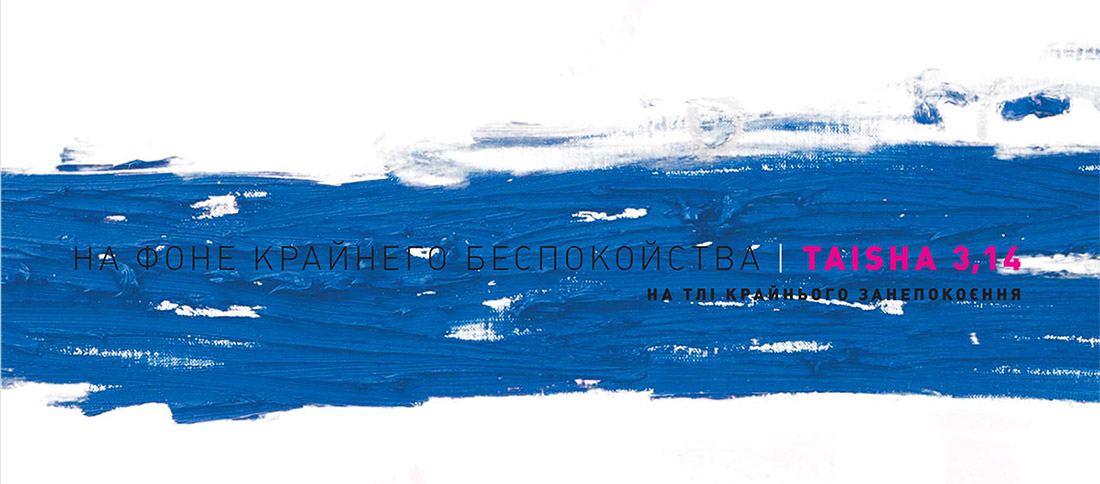
The personality of an artist known as Taisha 3,14 is veiled in mystery. Even her real name is revealed to very few people. Although her artistic career started only a short time ago, she has already gained high recognition by well-known Ukrainian masters and experts. Her works were sold at Phillips auction house and are currently held in private collections in Ukraine, Russia, Germany and the USA.
The creative pseudonym Taisha 3,14 was selected by no mere chance. Since she was a child, the artist felt that living with the name recorded in her documents makes her feel uncomfortable. Practicing numerology and astrology, she acquired her spiritual name. Its first component represents an interpretation of the artist’s shortened familiar name. Its second component – the number Pi – bears a special symbolic meaning. The essence of this number, its mystery, endlessness and absolute irrationality invite a comparison with life itself. It may be said that the number Pi is an allegory of the Universe.
The largest period of the artist’s life is linked to the East, its culture and spiritual practices finding a reflection in her art. Inscriptions in Hindi and Sanskrit are a cross-cutting motif of her works. These inscriptions are not just an ornamental background, as it may seem at first glance. Each inscription means a certain taboo, the overcoming of which is shown in the painting’s narrative. Strong emphasis is laid on inner energy and the ways of its release outside. The artist reflects on how important it is to target vital forces in the appropriate direction and how dangerous it is for a person to retain energy inside.
The coloring of canvases makes one think about the diverse palette of the East: sunny yellow, ardent orange-pink, desert-like sandy brown catch the eye. Besides, Taisha 3,14 uses her own system of signs and symbols which have a sacral nature. The main of these symbols is the heart which can be seen on the majority of pictures. This is an anatomically correct image which may be accompanied by an imitation of a cardiogram; this is also exaggeratedly schematic hearts. In her works the artist repeatedly depicts a motorcycle which may be interpreted as her efforts to overcome her own fears. A separate element worthy of special attention is a spider appearing on the canvasses on a regular basis. This is another way of looking into the eyes of own fear and make the first step towards overcoming it.
The artist eagerly uses street-art elements. On a background print made in advance she puts stencil images and deliberately slipshod inscriptions – we are used to see such elements on walls rather than on canvasses. Some paintings have a checked background making them look like a geographical map. Such infantilism pretence is in a surprising manner interwoven with oriental motifs. And all this together makes up the artist’s inner world.
* * *
The works «Lava» and «Brain» are dedicated to potential energy hidden in every individual. The artist emphasizes that human inner forces should be used correctly. She compares them with seeds which should sprout or lava which should burst out of a volcano. The artist warns: energy which an individual blocks inside or spends for stereotyped whims of society will rebound at him or her. If no flower grows from a seed, roots will tear the soul apart from within, and a volcano will explode under the pressure of the lava. Red and black colors non-typical for the artist’s works indicate that human energy has a fiery nature.
* * *
Love is the key motif in works by Taisha 3,14. Almost every painting depicts a heart. For the artist love is a no less radical thing than riding a motorcycle. For her both of them are the test for courage. Maybe this is why a heart and a woman on a motorbike often neighbor on the paintings by her.
* * *
The emotional reaction of the artist evoked by recent events in Ukraine resulted in a series of objects under the common title «Adverse Effects». These are warning signs which almost shout out loud: TANKS ARE NEAR! The objects are fastened by fragments of different paintings symbolizing the problem and the action provoked by it. Real warning signs are fastened on top, with symbols of potential adverse effects and possible materialization of something awful painted on them by the artist’s hand:
- disease → needs medicines → possibility of adverse effects;
- wrong president → dissatisfaction → possibility of war;
- greed → lawlessness → possibility of imprisonment;
- mercy → hard labor → possibility of reward;
- good → make good → possibility of either gratitude or punishment;
- evil → make evil → possibility of punishment;
- love → marriage → possibility of divorce;
- desire → aspiration → possibility of devastation;
- spirituality → prayer → possibility of unity with the Divine;
- meditation → quiet → possibility of brain silence.